




20240830145908.gif)

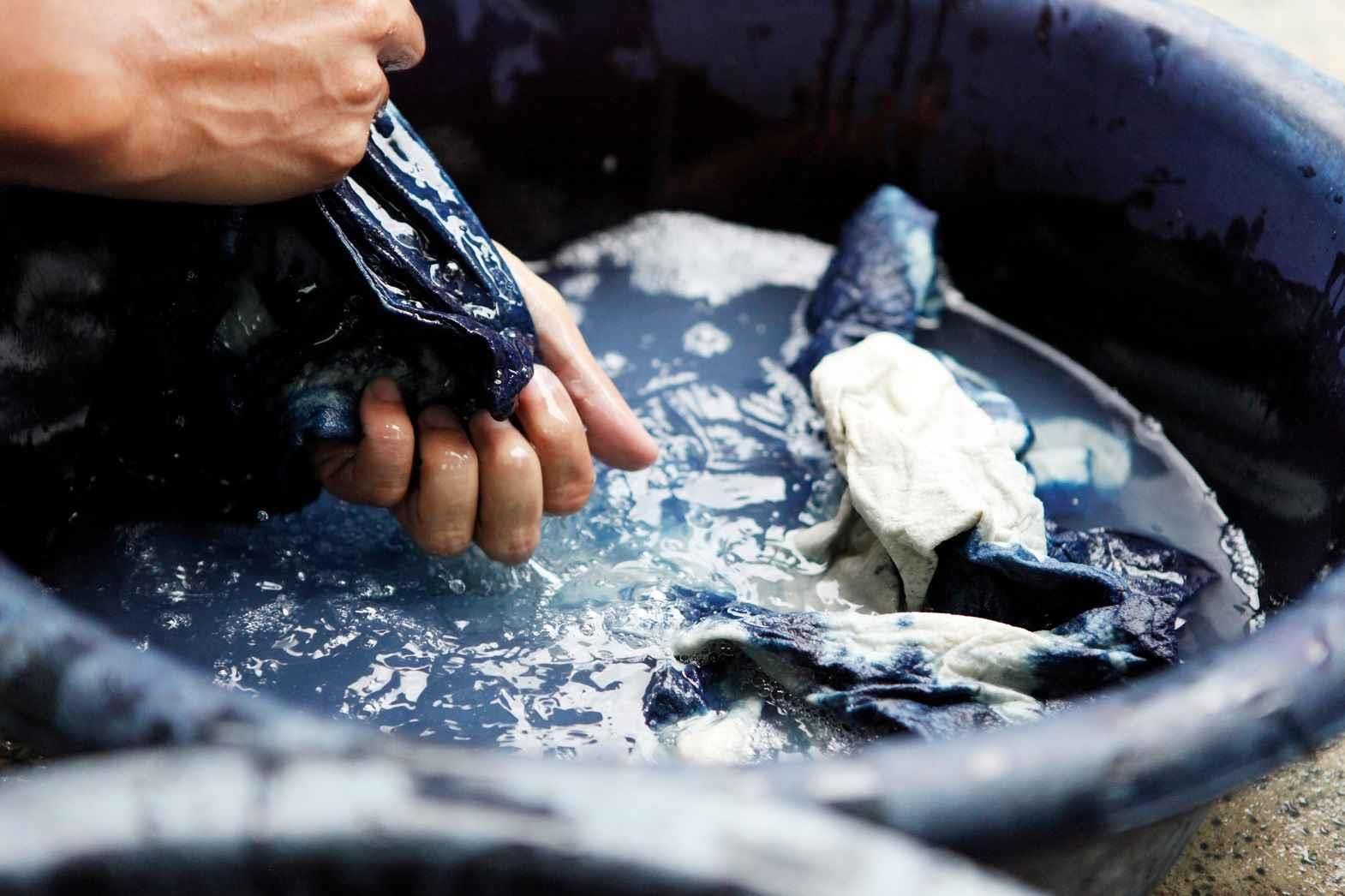
The process of applying colour to fibre stock, yarn, or fabric is called dyeing. There may or may not be thorough penetration of the colourant into the fibres or yarns.
Textile dyes include acid dyes, used mainly for dyeing wool, silk, and nylon, and direct or substantive dyes, which have a strong affinity for cellulose fibres. Mordant dyes require the addition of chemical substances, such as salts, to give them an affinity for the material being dyed. They are applied to cellulose fibres, wool, or silk after such materials have been treated with metal salts. Sulphur dyes, used to dye cellulose, are inexpensive but produce colours lacking brilliance. Azoic dyes are insoluble pigments formed within the fibre by padding, first with a soluble coupling compound and then with a diazotized base. Vat dyes, insoluble in water, are converted into soluble colourless compounds by means of alkaline sodium hydrosulphite. These colourless compounds are absorbed by the cellulose, which is subsequently oxidised to an insoluble pigment. Such dyes are colourfast. Disperse dyes are suspensions of finely divided insoluble organic pigments used to dye hydrophobic fibres such as polyesters, nylon, and cellulose acetates.
Reactive dyes combine directly with the fibre, resulting in excellent colourfastness. The first ranges of reactive dyes for cellulose fibres were introduced in the mid-1950s. Today, a wide variety is available.
Methods of Dyeing
- Bale Dyeing: A low-cost method to dye cotton cloth. The material is sent without scouring or singeing through a cold-water bath where the sized warp has an affinity for the dye. Imitation chambray and similar fabrics are often dyed this way.
- Batik Dyeing: One of the oldest forms of dyeing, originated in Java. Portions of the fabric are coated with wax so that only unwaxed areas take on the dye matter. The operation may be repeated several times, using multiple colours for a mottled or streaked effect, imitated in machine printing.
- Beam Dyeing: The warp is dyed before weaving by winding it onto a perforated beam and forcing the dye through the perforations, saturating the yarn with colour.
- Burl or Speck Dyeing: Mostly done on woollens or worsteds. Coloured specks and blemishes are covered by using special-coloured inks in many colours and shades. It is a hand operation.
- Chain Dyeing: Used when yarns and cloth are low in tensile strength. Several cuts or pieces of cloth are tacked end-to-end and run through a continuous chain in the dye colour, allowing for high production.
- Cross Dyeing: A popular method where varied colour effects are obtained in one dye bath for cloth containing fibres with different affinities for the dye used. For example, a blue dyestuff might give nylon 6 a dark blue shade, nylon 6,6 a light blue shade, and have no affinity for polyester, leaving it white.
- Jig Dyeing: Done in a jig, kier, vat, beck, or vessel in an open formation of the goods. The fabric goes from one roller to another through a deep dye bath until the desired shade is achieved.
- Piece Dyeing: The dyeing of fabrics in cut, bolt, or piece form. It follows the weaving of the goods and provides a single colour for the material, such as blue serge or green organdy.
- Random Dyeing: Colouring only certain designated portions of the yarn. There are three ways of doing this type of colouring: skeins may be tightly dyed in two or more places and dyed on one side of the dye with one colour and the other side with another; colour may be printed onto skeins spread out on the blanket fabric of the printing machine; or cones or packages of yarn on hollow spindles may be arranged to form channels through which yarn and dyestuff are drawn by suction, achieving random effects.
- Raw Stock Dyeing: Dyeing of fibre stock before spinning of the yarn, following the degreasing of wool fibres and drying of the stock.
- Solution Dyeing: Also called dope dyeing or spun dyeing. The pigment colour is bonded in the solution and picked up as the filaments form in the liquor. Both cellulosic and non-cellulosic fibres are dyed to perfection by this method. The colours are bright, clear, clean, and fast.
- Yarn Dyeing: Yarn dyed before weaving, following the spinning of the yarn. It may involve partial or total immersion of the yarn.
Process of Dyeing
The dyeing of a textile fibre is carried out in an aqueous solution known as the dye liquor or dye bath. For true dyeing to occur, both coloration and absorption are crucial.
- Colouration: The colouration must be relatively permanent, not readily removed by rinsing in water or normal washing procedures, and must not fade rapidly upon exposure to light.
- Absorption: The process of attaching the dye molecule to the fibre involves absorption, where dye molecules concentrate on the fibre surface. Four kinds of forces bind dye molecules to the fibre: ionic forces, hydrogen bonding, Van der Waals’ forces, and covalent chemical linkages.
Dyeing of Wool
Wool, a complex protein containing about 20 different amino acids, undergoes dyeing in a dye bath where sulphuric acid forms ionic linkages with the amino groups of the protein. The sulphate anion is replaced by a dye anion. In the dyeing of wool, silk, and synthetic fibres, hydrogen bonds are formed between various groups and the amino groups. Covalent chemical links are established in the dye bath by a chemical reaction between a fibre-reactive dye molecule and a hydroxy group of a cotton fibre in the presence of alkali.
The Chemistry of the Dyeing Process
In any dyeing process, regardless of the chemical class of dye used, heat must be supplied to the dye bath. Energy is used to transfer dye molecules from the solution to the fibre and to swell the fibre, rendering it more receptive. This process is known as exhaustion.
Levelness: An Important Quality
Evenness of dyeing, or levelness, is an important quality in dyeing natural and synthetic fibres. It can be attained by controlling dyeing conditions, such as agitation to ensure proper contact between dye liquor and the substance being dyed, and by using restraining agents to control the rate of dyeing.
Solvent Dyeing
Recent consideration has been given to dyeing methods where water is replaced by solvents like chlorinated hydrocarbons used in dry cleaning. Advantages of solvent dyeing include rapid wetting of textiles, less swelling, increased dyeing speed, energy savings, and elimination of effluent (pollution) problems associated with conventional dyeing and finishing methods.
Machinery and Equipment
Modern dyeing machines are made from stainless steel, with steels containing up to four per cent molybdenum preferred to withstand acid conditions. A dyeing machine consists of a vessel to contain the dye liquor, equipped for heating, cooling, and circulating the liquor around the goods to be dyed or moving the goods through the dye liquor. The choice of machine depends on the nature of the goods to be dyed.
Common Dyeing Machines
-
Conical-pan loose-stock machine: Used widely, with fibresheld in an inner truncated conical vessel while the hot dye liquor is pumpedthrough.
-
Hussong machine: Traditional apparatus with a long,square-ended tank for the dye bath, improved circulation, and better levelling.
-
Package-dyeing machines: Dye colour can be pumped throughperforated spindles in either direction for even dyeing, capable of workingunder pressure at temperatures up to 130oC.
-
Winch: The oldest dyeing machine, moving cloth through thedye liquor via a slated roller. Pressurised-winch machines have been developedin the US.
-
Gaston County jet machine: Circulates fabric through a pipewith a high-pressure jet of dye colour, important for high-temperature dyeingof synthetic fibres.
-
Jig: Holds dye colour in a V-shaped trough, with guide rollers carrying cloth between two powered rollers, moving forward and backward through the dye colour until dyeing is complete. Modern jigs are automatically controlled and programmed for pressure work.





Comments